

Ty Lumnus
Based In: Glasgow, Scotland

Artist Bio:
Glasgow’s Ty Lumnus crafts immersive sonic worlds where time bends and melodies breathe. Using modular synthesis as his primary instrument, he weaves melodic dystopian soundscapes that drift between John Carpenter’s nostalgic synth atmospheres and meditative ambient territories. This isn’t music for the dancefloor – it’s music for the mind.
Artist Statement:
My style is lots of reverb. Big pads, Synthesised strings. Repetitive melodies all based on slightly different lengths of tracks which means you rarely hear the same sequence repeat.
I tend to build up soundscapes then use modules such as the Arbhar and Lubadh modules to loop, process and translate the overall sound into something quite different. Fuzzy yet related to the original track.
If there are beats they tend to be running at half speed.
If the tracks are not sounding beautiful they can be quite dystopian and claustrophobic - always with a hint of optimism chinking through the clouds. Due to the use of lfo’s modulating the majority of filter parameters at different time cycles the parts drift in and out. Everything is based on repetition. It can be hypnotic.
Related Links:
Linktree -
Insta - https://www.instagram.com/tylumnus
Live performance at Wavetable Nov 2025 - https://www.youtube.com/watch?v=9De9gQLZ9hM
YouTube channel - https://www.youtube.com/@TyLumnus
10 Questions with Ty Lumnus
Q.1:
To begin, could you share a little about how the project Ty Lumnus first emerged? What initially drew you toward modular synthesis and phase-based composition?
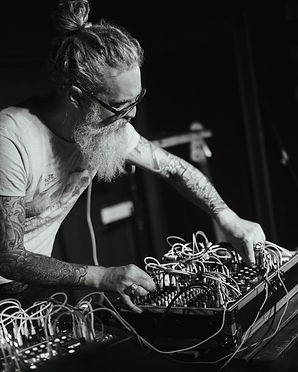
From a very early age I’ve been involved with music. Mid teens I discovered a love of writing repetitive music, with guitars a few old effects pedals and an old cassette 4-track. After many years in a number of bands I started to work with Ableton which transformed my work flow and opened up a whole world of sounds at my fingertips. That’s when I started bringing in synths to my music. I now write and perform almost exclusively on modular synths. For me, they have more freedom than conventional fixed architecture synths.
Q.2:
Your work often engages with repetition, subtle shifts, and long-form structures. What interests you about time and gradual transformation as compositional tools?
I love to get pulled into the music. I find repetition to be much more emotive than verse/chorus type music. It’s got to gradually change and morph overtime though - it needs to be dynamic rather than static.
Q.3:
Many listeners describe your music as immersive and meditative, yet also intellectually rigorous. How do you personally think about the balance between emotional experience and structural experimentation?
I’m not a classically trained musician. Everything I do is by feel and sound. It is almost a form of ignorance that allows me musical freedom to try things and find my own way.

Q.4:
Modular synthesis involves both control and unpredictability. How do you approach this relationship between intention and accident in your creative process?
There are a vast number of ways to play a modular synth. Modular is well known for its non-musical bleeps and gruff sounds. Many artists build complex generative patches that self play and are unpredictable. Most completely strip their system and start from scratch after each session. I’m quite unusual for a modular artist. I spent many years experimenting to get my rig to a place I want it and I leave it permanently patched. I treat it like my own band. My set up needs to be sequenced before it will play and each instrument acts independently. It’s the most un modular synth way to approach playing a modular synth, but it works for me.
Q.5:
Your performances and recordings seem to create a very focused listening space. When composing, do you imagine a specific environment, audience, or state of mind?
No - not at all. I always write just for me. In the past I’ve had audiences in mind - groups of people I specifically want to like what I’m doing but it is not a useful way to write - it doesn’t work for me. I don’t write to be popular though I suppose deep down I would like to be.
I start from a blank canvas and a blank mind. Anytime I’ve had something in my head and tried to reproduce it the output has taken a longtime to manifest and it is never been too great. I find working quickly selecting what works and what doesn’t yields the best results for me. For example, before this interview I spent 10mins or so writing a short sequence - a chilled repeating passage, adjusted all the time loops set up some LFOs to modulate the filters added a heap of reverb and delay and it has been running for 40mins now. It keeps surfacing new combinations of melody and rhythm and it keeps subtly changing.


Q.6:
Technology evolves rapidly, yet your work often feels timeless rather than trend-driven. How do you position yourself in relation to contemporary electronic music culture?
This is always an interesting question and I’m going to plead ignorance again. With very little knowledge of styles of music, in particular what is trending or new, I tend not to be influenced one way or another. Don’t get me wrong, I listen to a lot of music and no doubt those influences creep in.
Genres mean nothing to me.
When I was a kid I was the exact opposite. When I loved a sound I wanted to emulate it. I never understood the concept of being original (which sounds absurd). I was more interested in being associated with a type of tribe (I’ll confess it was being a goth). I could play other artists music but when ever I tried to write, for example goth music, it just didn’t work. It is actually quite difficult to be yourself when it’s perhaps not quite what you want to be. It’s only when you let yourself explore and to just trust and follow your ear you start to generate your own way of being that is completely natural and 100% you. When you are not looking to pigeon hole yourself it is a comfortable place to land - and space is all yours. It’s a happy place.
Q.7:
Alongside your work as Ty Lumnus, you’re also involved in academic life. Do you see a relationship between these two worlds? Are they independent spaces for you, or do they subtly feed into one another over time?
I consider myself a creative person. That’s what makes me tick, whether creative in the workplace or creative with music in the studio. I do tend to keep work and play separate though.

Q.8:
Modular synthesis has now existed for more than sixty years. From your perspective, do you feel there is still meaningful space for innovation within this field? If so, where do you imagine that innovation might emerge — technologically, compositionally, or perhaps conceptually?
Another great question. Modular synths were the first type of synth. They were not really too portable and they were prohibitively expensive. They still are. The biggest transformation was to a universal format (size) called Eurorack (which is also cheaper than the others). Most modular synth manufacturers build their products in the Eurorack format and that makes them easily integrated to any system. Manufacturers are from 1 person in size to 30-50 people for the bigger more established companies. These folks are always creating new modules that do different exciting things. The scene is constantly innovating. There is a software platform called VCV racks that models modular synths. Most companies create a digital version of their modules to go into VCV racks and it is mostly free. The scene is constantly evolving and growing.

Q.9:
You share your practice not only through releases but also through online platforms and documentation. How important is transparency or process-sharing to you as an artist?
It is not too important. I like people to see how I make music especially in environments when people can come up and talk to me when I’m playing. Seeing the excitement mixed with disbelief when they realise that the music they are listening to is coming from the boxes of wires. (They often don’t believe me to begin with so I’ll isolate and instrument and allow them to adjust it so they can see, hear and feel it for themselves.)
I’m not hung up of how people make music. Some like a laptop. I don’t find that as rewarding.
Q.10:
Finally, looking ahead, are there directions — whether musical, collaborative, or interdisciplinary — that you feel especially curious about exploring in the coming years?
Thats something that I don’t usually tend to plan. I prefer serendipity. It would make me immensely happy to just have some space and time to write, record and perform more.
I have an album coming out shortly on Glasgow based label Astral Discs. The launch will be at Bloc Wed 29th April when I will be playing live. That’s the thing I’m looking forward to most at the moment.
I also play in Big Slope with another artist every couple of months. He plays lapsteel and I play my modular rig - usually 3 hrs sets 8-11pm on a Sunday night. (Keep an eye on my social media for info on that.)
That sequence has now been rolling for about 90mins and is still sounding lovely.